SG-ready heat pumps
The Currentt Navigator can control heat pumps via the SG-ready protocol.
Check in advance whether the heat pump you are connecting to supports the SG-ready protocol. Consult the specifications and/or installation manual of the heat pump in question.
📋 Overview
SG-ready (Smart Grid Ready) is a label issued by the German Bundesverband Wärmepumpe (BWP) certifying that a heat pump can respond to external control signals from the electricity grid, an energy management system or a PV installation.
The goal of SG-ready is to make heat pumps flexibly deployable: they can be controlled based on electricity prices, on-site solar generation or the current load on the grid. This makes heat pumps cheaper to operate and contributes to a stable and sustainable energy system.
Use cases
Increasing self-sufficiency
Combined with solar panels, the Currentt Navigator can switch on the heat pump whenever locally generated electricity exceeds consumption. Surplus solar energy is converted into heat and stored in the domestic hot water tank or buffer tank as a thermal buffer. This increases self-consumption, reduces dependence on the grid and avoids feeding surpluses back at low tariffs.
Cost savings with dynamic electricity prices
With a dynamic electricity contract, the price fluctuates throughout the day. The Currentt Navigator can automatically schedule the heat pump to run during the cheapest hours and block it when electricity is expensive, reducing energy costs without sacrificing comfort.
Supporting the electricity grid
Heat pumps can also be used to stabilize the electricity grid. When there is a surplus of electricity on the grid — and therefore a frequency that is too high — the Navigator can instruct the heat pump to increase its power consumption. When there is a shortage, the heat pump can be temporarily blocked to relieve the grid.
⚙️ How it works
An SG-ready heat pump has two digital inputs, typically labelled SG1 and SG2. By switching these inputs open or closed, four possible combinations are created — and therefore four operating modes the heat pump can run in.
The Currentt Navigator drives these two inputs via two external contactors. The Navigator switches the coil of each contactor; the potential-free contact of the contactor then closes the corresponding SG input on the heat pump.
Why two contactors?
How the SG inputs need to be driven differs per manufacturer. There are roughly two variants:
- Potential-free (low voltage). The inputs operate at low voltage (typically 5–24 V DC) supplied by the heat pump itself. They may only be closed through a potential-free dry contact, without any external voltage.
- Switched phase (230 V). The heat pump expects the phase conductor (L) to be switched onto the SG input. The input is active as soon as 230 V is present.
A contactor handles both variants. In all cases the Navigator only switches the 230 V coil of the contactor; the heavy-duty make contact is then used to close the SG input — either potential-free, or by switching phase L onto the input:
- Potential-free heat pumps: the make contact briefly shorts the two SG terminals together, without applying any external voltage to the input. This provides galvanic isolation between the Navigator and the heat pump.
- Heat pumps with switched phase: the make contact applies phase L to the SG input. Because the heavy-duty power contact handles this, the Navigator itself remains fully separated from the 230 V control circuit going to the heat pump.
Because the Navigator is never wired directly to the SG inputs, the installation stays safe, robust and compliant with virtually every manufacturer's specification.
Operating modes
The four SG-ready operating modes are determined by the combination of the two switch contacts (SG1 and SG2). The Navigator continuously selects the mode that matches the current electricity price, solar generation or grid load.
| Mode | Description | SG1 | SG2 |
|---|---|---|---|
| Mode 1 — Blocked | The heat pump is blocked. According to the SG-ready specification this is allowed for at most two hours per day (and no more than two consecutive hours), so that comfort remains guaranteed. | Closed | Open |
| Mode 2 — Normal | The heat pump runs according to its own energy-efficient control logic. This is the default mode and also applies in the event of a power failure or a broken control cable. | Open | Open |
| Mode 3 — High | The heat pump is encouraged to consume more electricity, for example by raising the hot water temperature slightly or prioritizing space heating. The heat pump itself decides how to act on this signal. | Open | Closed |
| Mode 4 — Maximum | The heat pump is forced to run at full power. Two variants are possible (configurable on the heat pump): i. the heat pump is switched on ii. the heat pump is switched on AND the hot water temperature is raised | Closed | Closed |
If both contacts open — for example due to a broken cable or a powered-off Navigator — the heat pump automatically falls back to Mode 2 (Normal). The installation therefore always remains functional.
🧰 Requirements
Check in advance whether the heat pump you are connecting to supports the SG-ready protocol. Consult the specifications and/or installation manual of the heat pump in question.
- Currentt Navigator Pro
- 2 contactors (one per SG input), for example:
- Installation cable to connect the Navigator, the contactors and the SG inputs of the heat pump
🪛 Installation instructions
The Currentt Navigator is connected via two relay outputs to the coils of the two contactors. The potential-free contacts of the contactors are then wired to the SG1 and SG2 inputs of the heat pump, as shown in the diagram below.
- Connect output 1 of the Navigator to A1 of contactor 1, and the neutral to A2. Do the same with output 2 and contactor 2.
- Connect the make contact of contactor 1 to the SG1 input of the heat pump and that of contactor 2 to the SG2 input.
- With both outputs off, the heat pump is in mode 2 (normal operation), the safe default position.
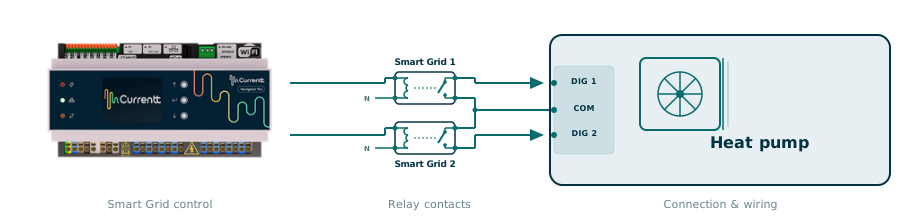
The exact name and location of the SG inputs differs by brand and model. Consult the installation manual of your heat pump to find the correct terminals and to enable the SG-ready function in the service menu.