Hager ECR380D energy meter
This guide describes how to connect a Hager ECR380D three-phase energy meter for DIN rail mounting (4TE) to the Currentt Navigator via Modbus RTU over RS485.
The Hager ECR380D is a three-phase energy meter with RS485 Modbus RTU interface. The meter is suitable for DIN rail mounting and is widely used in distribution boards.
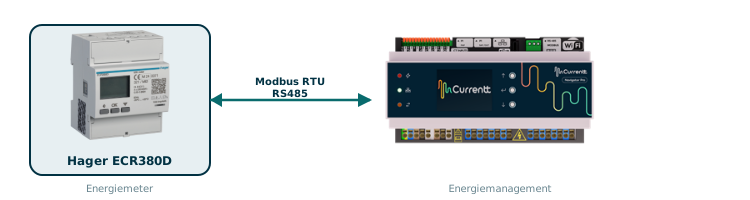
The Hager ECR380D uses Even parity and a baud rate of 19200 by default. This differs from most other meters. Set the Currentt Navigator to Even parity and 19200 baud for this meter.
Make sure each device on the RS485 bus has a unique Modbus address.
🔀 Variants
| Variant | Energy calculation |
|---|---|
| ECR380D | Magnitude summation (Welmec method) |
| ECR382D | Vector summation |
Firmware: Firmware version 1.2 or higher is recommended.
🔌 Connecting the meter
The meter is connected to the Currentt Navigator using a twisted pair data cable (for example CAT5 or CAT6 UTP). The cable contains two signal lines (A+ and B-) and optionally a ground connection. Always use a twisted pair for the signal lines — the twisting suppresses electromagnetic interference (EMI) and is essential for a reliable RS485 connection.
Connect the RS485 cable to the designated terminals on the ECR380D.
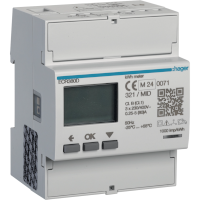
Hager ECR380D: RS485 connection terminals
Always use a twisted pair for the A and B signal lines. The twisting of the pair suppresses electromagnetic interference (EMI) and is essential for a reliable RS485 connection, especially over longer distances.
Connect the ground on one side only: either to the Currentt Navigator or to the meter — but never on both sides. Connecting ground on both sides can cause a ground loop, leading to communication errors or equipment damage.
Connecting to the Currentt Navigator
| Hager ECR380D | Currentt Navigator |
|---|---|
| A+ | A+ |
| B- | B- |
Bus topology
Preferably use a daisy-chain (series) topology. At short distances (< 25 meters), a star topology often works as well. Connect a maximum of 32 devices to a single RS485 bus. Place a 120 Ohm termination resistor at both ends of the bus.
The Currentt Navigator has a built-in termination resistor that can be enabled or disabled via software. By default, it is enabled.
⚙️ Configuration in the Currentt Navigator
After physically connecting the meter, the device must be added in the Currentt Navigator. This can be done in two ways:
Via the setup wizard (recommended)
- Click the settings icon (top right of the screen)
- Choose Setup wizard
- Follow the on-screen steps
Manual configuration
- Click the settings icon (top right of the screen)
- Go to Components
- Click the + button in the Meters section
- Select Hager
- Choose the model ECR380D
- Specify what the meter will measure:
- Consumption and generation — the meter measures both consumption and feed-in (bidirectional)
- Consumption only — the meter measures consumption only
- Generation only — the meter measures generation only (for example, behind an inverter)
- Specify which phases the meter is connected to (L1, L2, and/or L3)
- Under Communication, select RS-485
- Set the communication parameters. The meter's default settings are pre-filled in the Navigator (see settings summary)
Additional options
- Measurement range: If possible, specify the measurement range in amperes that will be measured.
- Reverse meter direction: If the meter is physically installed in the wrong direction, the measurement direction can be reversed in software. This prevents the meter from registering consumption as generation (or vice versa) without physically reversing the meter.
- Use as PAP: This meter can also be used to measure the main connection (PAP, primary allocation point). In that case, select the "Use as PAP" option during configuration.
📋 Settings summary
| Parameter | Value |
|---|---|
| Brand | Hager |
| Model | ECR380D |
| Type | Three-phase energy meter |
| Baud rate | 19200 |
| Data bits | 8 |
| Parity | Even |
| Modbus address | Configured on the meter |
| Energy calculation | Magnitude summation (Welmec) |
| Minimum firmware | 1.2 (for Wh resolution) |
🛟 Troubleshooting
| Problem | Possible cause | Solution |
|---|---|---|
| No communication | Baud rate is set to 9600 instead of 19200 | Set the baud rate to 19200 in the Currentt Navigator |
| No communication | Parity is set to None instead of Even | Set parity to Even in the Currentt Navigator |
| No communication | Wrong A/B wiring | Swap the A and B wires |
| No communication | Wrong Modbus address | Verify that the address matches in both the meter and the Navigator |
| Inaccurate energy values | Firmware too old | Verify that firmware version 1.2 or higher is installed |
| Difference with ECR382D | Different summation method | ECR380D uses magnitude summation (Welmec), ECR382D uses vector summation |
| Intermittent communication | No twisted pair used | Use a twisted pair for the signal lines |
| Intermittent communication | Termination missing | Enable the termination resistor on the last device in the chain |
| Timeout errors | Wrong baud rate | Make sure the baud rate is 19200 on both sides |